Closing the Translation Gap Between Operational Need and Software Delivery
How Alchemist AI Pro™ Helps Preserve Mission Intent
BLUF: Alchemist AI Pro™ is Tradewinds-awardable and reduces drift by ensuring alignment between what the mission needs and what the software development teams build.
Purpose
Large organizations do not usually lack operational knowledge; the challenge is converting that knowledge into software requirements that software development teams can actually use.
For those in charge of information systems, this translation challenge sits at the intersection of operational need, information advantage, cyber risk, data use, and capability delivery.
Alchemist AI Pro™ is designed for that intersection and helps commanders and staff turn mission knowledge, user input, doctrine, policy, data constraints, and cyber considerations into clear, traceable, testable software requirements—so the organization can write better requirements earlier, preserve operational intent, and reduce rework before development begins.
The Problem: Operational Need Gets Translated Too Many Times
Operational needs begin with people who understand the mission.
As those mission requirements change hands through layers of abstraction (notes, slides, taskers, etc.), the original idea may become incomplete or unclear due to untraceable drift.
For example, a staff section may know that operators need faster access to information environment indicators; however, by the time that need becomes a development task, the requirement may not clearly say which users need the data, what decisions the data supports, which sources are authoritative, what cyber constraints apply, or how success will be tested. The software team will build and test the product successfully; however, the risk is that requirements may drift further away from the original operational need as project artifacts are created. Over time, the final solution may be technically complete but operationally misaligned.
This is why high-quality requirements matter. GAO notes that requirements, including user stories, help ensure that the final product functions as intended and that best practices include eliciting, prioritizing, and ensuring work meets those requirements (Government Accountability Office, 2020). That sounds basic, but it is where many software efforts begin to lose time.
Many times, cyber requirements are treated as review gates rather than foundational design inputs while data constraints are often discovered after people already assume the data has already been modeled. NIST's Zero Trust guidance reinforces that modern security must focus on protecting resources, assets, services, workflows, and accounts rather than relying on old network-boundary assumptions (Rose et al, 2020).
The issue is not that teams cannot write. The issue is that operational knowledge is often converted into software language through an informal process that depends too much on who happens to be in the room.
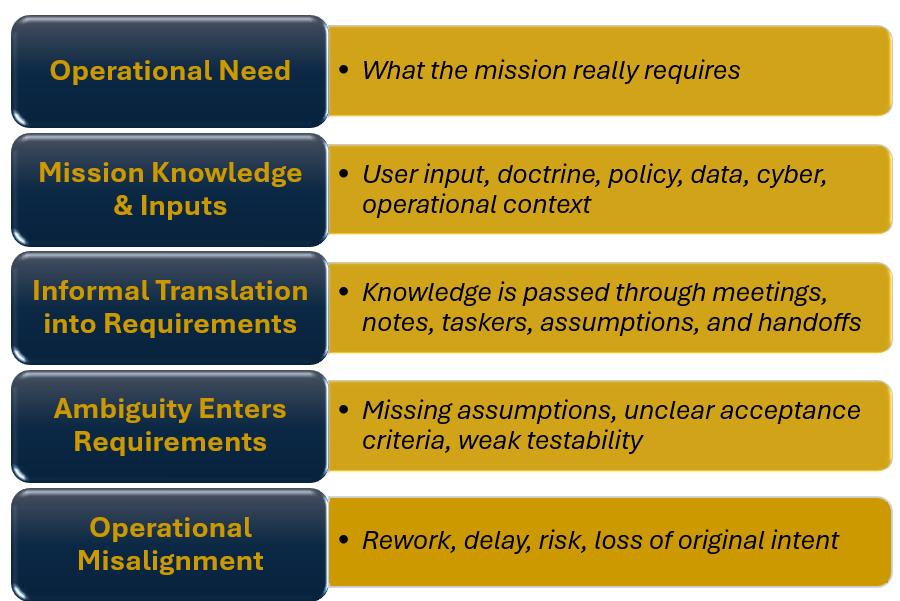 Figure 1. Operational Misalignment
The Solution: Alchemist AI Pro™ Helps Staff Write Requirements Software Teams Can Use
Alchemist AI Pro™ is built around a practical idea: before software can deliver capability, the organization must write its requirements well.
Alchemist AI Pro™ turns operational knowledge into structured requirements, which capture the mission requirements mapped to use cases that express the required elements and institutional knowledge in a traceable format from inception to product sunset. Alchemist AI Pro™ was created with requirements stability and auditability in mind.
Requirements are not just words in a backlog; they bridge intent and execution informing leadership of which need is being addressed. Requirements tell the developer what must be built and the tester what must be verified. Requirements ensure alignment between the delivered capability and the original mission purpose.
Alchemist AI Pro™ is not a generic AI writing tool. Its value is more specific; helping to discipline the translation from need to capability. Prompting the right questions, it exposes missing assumptions. It helps users move from broad statements of need to requirements that are clearer, more testable, and easier to align with development work.
That is directly relevant to the Department’s software modernization objective of delivering resilient software capability at the speed of relevance (Department of Defense, 2022). Speed does not come from writing vague requirements faster. It comes from reducing the avoidable confusion that slows delivery later.
 Figure 2. Alchemist AI Pro™ increases alignment
This is also where Alchemist AI Pro™ supports broader data and AI adoption. The Department’s 2023 Data, Analytics, and Artificial Intelligence Adoption Strategy emphasizes the need to strengthen the environment in which DoD deploys data, analytics, and AI capabilities (Department of Defense, 2023). That environment depends on more than technical tools. It depends on whether the organization can state the need, define the constraints, and turn mission knowledge into something executable.
The Benefits: Less Rework, Better Alignment, and a Repeatable Process
The benefits of Alchemist AI Pro™ are immediate: you'll see more accurate requirements, fewer assumptions, better translation through layers of abstraction, and retention of institutional operational knowledge ensuring alignment to the mission strategy.
For a senior information leader, the value is practical:
- Less rework. Poor requirements create downstream cost when developers build assumptions that are discovered late into the product, Alchemist AI Pro™ surfaces missing details earlier in the process lowering cost and decreasing risk.
- Faster development alignment. Agile teams perform at a higher rate specific, bounded, and testable requirements. Alchemist AI Pro™ helps staff move from general need to implementation-ready language.
- Better preservation of operational intent. The operational purpose of a capability is clearest at the beginning. Alchemist AI Pro™ helps carry that purpose into user stories, acceptance criteria, data assumptions, and cyber considerations.
- Fewer late cyber and data discoveries. Cyber and data constraints should shape the requirement, not surprise the team after development starts. Alchemist AI Pro™ helps bring those considerations into the writing process earlier.
- Improved continuity. Organizations cannot afford inertia. A repeatable requirements process gives the organization continuity by reducing dependence on institutional knowledge and preserving the intent behind each requirement as postures change.
- A cleaner path from need to capability. The goal is not more documentation. The goal is a better handoff from the people who understand the mission to the people responsible for building the capability.
 Figure 3. Benefits of Alchemist AI Pro™
Alchemist AI Pro, submitted as the “Accelerating the Mission” solution, has also been assessed as “Awardable” through CDAO’s Tradewinds Solutions Marketplace. CDAO describes the marketplace as a repository of post-competition, readily awardable pitch videos for AI/ML, digital, and data analytics solutions (Chief Digital and Artificial Intelligence Office, 2022). That status is not an award, endorsement, or selection but rather, a procurement-readiness signal. The solution passed a structured assessment and is available for rapid consideration by government customers.
For a buyer, Tradewinds awardable status reduces perceived risk and shortens the most complex part of the procurement process. It does not remove the need to assess mission fit, security, integration, or contracting details. But it does mean Alchemist AI Pro has already cleared an important government-facing assessment step.
Getting Started with ACC3 International
ACC3 International recommends a focused demonstration with your team or designated staff representatives. Please contact ACC3 International to schedule a demonstration of Alchemist AI Pro™ and assess how it can help improve the path from operational need to software-enabled information capability.
References
Chief Digital and Artificial Intelligence Office > Industry > Tradewinds. (2022). Ai.mil. https://www.ai.mil/Industry/Tradewinds
Department of Defense. (2022). Department of Defense Software Modernization. https://media.defense.gov/2022/feb/03/2002932833/-1/-1/1/department-of-defense-software-modernization-strategy.pdf
Department of Defense. (2023). Data, Analytics, and Artificial Intelligence Adoption Strategy. https://media.defense.gov/2023/nov/02/2003333300/-1/-1/1/dod_data_analytics_ai_adoption_strategy.pdf
Government Accountability Office. (2020, September 29). Science & Tech Spotlight: Agile Software Development. US Government General Accountability Office; GAO-20-713SP. https://www.gao.gov/products/gao-20-713sp
Rose, S., Borchert, O., Mitchell, S., & Connelly, S. (2020). Zero trust architecture. NIST Special Publication 800-207, 1(800-207). https://doi.org/10.6028/nist.sp.800-207